
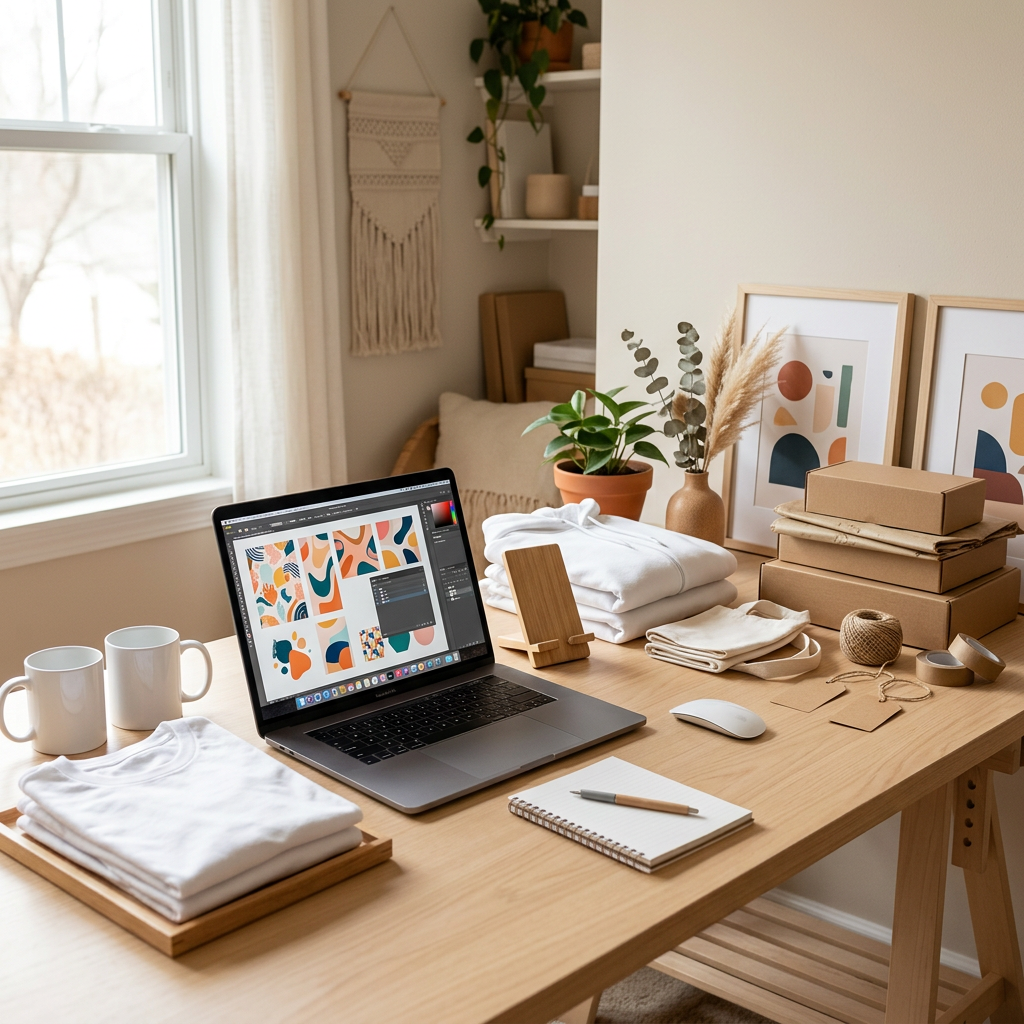
Start for free, sell custom products online, and pay Printful when your customers place orders
Affiliate Disclosure: DADYMINDS Holdings LLC participates in an affiliate relationship with Printful. If you use our referral link and subsequently make a qualifying purchase or subscription through Printful, DADYMINDS Holdings LLC may receive an affiliate commission. This relationship does not increase your price. We disclose it because readers should understand the commercial relationship behind this recommendation.
👉 Start Your Print-on-Demand Business With Printful
Printful Review: Is It a Smart Way to Build an Ecommerce Merch Brand?
Starting an ecommerce brand sounds exciting.
Create a logo.
Design some products.
Open a store.
Advertise.
Make sales.
Build a community.
Eventually, turn the business into a recognizable brand.
But there is a problem that many new entrepreneurs discover very quickly:
Inventory costs money before you make a sale.
If you want to sell 100 custom T-shirts, you may need to buy those 100 shirts before you have customers.
Then you have to store them.
You have to package them.
You have to ship them.
You have to manage different colors and sizes.
You have to deal with unsold inventory.
You have to guess which designs people will actually want.
And if the product does not sell?
Your money is still sitting in a warehouse.
That is one of the reasons print-on-demand has become such an attractive ecommerce model.
Instead of manufacturing products in advance, a print-on-demand provider produces the product after a customer places an order.
Printful is one of the best-known companies operating within this model. The company says its platform allows sellers to start for free, create custom products, connect ecommerce stores, and pay for fulfillment when orders are placed rather than carrying traditional inventory.
For entrepreneurs, creators, influencers, artists, authors, organizations, and ecommerce businesses, this can dramatically reduce the barrier to launching a merchandise brand.
And that is why DADYMINDS HOLDINGS LLC is inviting entrepreneurs to explore Printful.
👉 Join Printful Through the DADYMINDS Affiliate Link
What Is Printful?
Printful is a print-on-demand and ecommerce fulfillment company.
Instead of requiring you to purchase a large quantity of products before selling them, Printful lets you create designs for products and have those products produced when customers place orders.
Printful’s current catalog includes hundreds of customizable products, including apparel, accessories, home and living products, posters, stationery and other merchandise categories. Its current pricing page lists 538 custom products available on the free plan.
The basic concept is:
You create the brand.
You create or choose the design.
You connect your store.
Your customer places an order.
Printful produces the item.
Printful fulfills and ships it.
This lets an entrepreneur focus more heavily on branding, marketing, customer acquisition and product strategy rather than buying inventory and operating a warehouse.
The Print-on-Demand Business Model Explained
Print-on-demand is easy to understand once you see the difference between traditional inventory and on-demand production.
Traditional ecommerce
You purchase inventory first.
Money → Inventory → Storage → Marketing → Customer → Sale
The risk is that you may buy products that do not sell.
Print-on-demand
The customer purchases first.
Marketing → Customer → Sale → Production → Fulfillment → Delivery
The inventory risk is reduced because products are produced only after an order is placed.
Printful explicitly describes its model as producing products on demand, with no minimum order requirement and no need to hold conventional inventory.
That does not eliminate business risk.
You still have advertising costs, platform fees, design costs, taxes, refunds, customer-service responsibilities and the possibility that your products simply do not sell.
But it changes the economics of starting the business.
Why Print-on-Demand Is Attractive to New Entrepreneurs
Imagine you have an idea for a streetwear brand.
You want to test:
Five T-shirts.
Three hoodies.
Two hats.
A few tote bags.
Under a traditional manufacturing model, testing those ideas could require significant upfront spending.
Under print-on-demand, you can create the products digitally, publish them online and allow demand to determine which designs deserve more attention.
That creates a powerful entrepreneurial principle:
Test before you scale.
Instead of investing heavily in a product before knowing whether customers want it, you can test demand through real-world sales.
If a design sells well, you can build more marketing around it.
If a design receives no interest, you can remove it.
This makes print-on-demand particularly suitable for experimentation.
The DADYMINDS Invitation
DADYMINDS HOLDINGS LLC is inviting ecommerce entrepreneurs, creators and founders to explore Printful as part of their merchandise strategy.
Get started for free. Pay only when a customer buys from your website.
Printful currently offers a Free plan at $0/month with access to its product catalog, design tools, store integrations and automated fulfillment.
That makes it possible to experiment with the platform without paying a mandatory monthly software subscription simply to create products and connect a store.
👉 Start With Printful Through DADYMINDS
“Pay Only When a Customer Buys” — What Does That Actually Mean?
This statement is attractive, but it is important to understand exactly what it means.
Printful says there are no upfront or monthly fees for its Free plan, and that sellers pay when products are ordered and require fulfillment.
However, the customer payment does not simply go directly to Printful.
Printful explains that your customer pays your ecommerce business through your chosen payment provider, while Printful separately charges you for the product, shipping and applicable taxes or other services associated with fulfillment.
For example:
You sell a shirt for $35.
The customer pays your store $35.
Printful then charges you the applicable fulfillment cost, shipping and taxes.
The amount left after your costs is your gross profit before other business expenses.
This distinction is extremely important for beginners.
Printful does not magically pay you a profit.
You still have to price products intelligently.
How Printful Profit Margins Work
Printful’s current pricing guidance summarizes the basic formula as:
Profit = Retail Price – Printful Cost
Your actual business profitability is more complicated because you may also have:
- Payment-processing fees
- Ecommerce-platform fees
- Advertising costs
- Refunds
- Discounts
- Taxes
- Software costs
- Influencer commissions
- Design expenses
- Customer-service expenses
But the basic product calculation is useful.
Suppose:
Retail price: $30
Printful product and fulfillment costs: $18
Your gross product margin before additional business expenses would be:
$12
If you spend $6 acquiring the customer through advertising, your remaining contribution could fall to:
$6
This is why product pricing should never be based only on what competitors charge.
Your price needs to support your entire business model.
Printful’s Product Pricing
Printful says its product price generally includes:
- The blank product
- One standard print or embroidery design placement
- Fulfillment
Additional expenses can apply to shipping, taxes, additional design placements, labels, branded packaging, embroidery digitization and other optional services.
This structure is relatively transparent.
It also means merchants should calculate the fully loaded cost before advertising a product.
A product that appears inexpensive in the catalog may have additional costs when you add:
Extra print locations.
Branded labels.
Premium imagery.
Special packaging.
International shipping.
Taxes.
Those costs should be incorporated into the retail price.
Why No Minimum Order Quantity Matters
One of the most attractive aspects of Printful is that you can order products individually.
Printful states that there is no minimum order requirement for its print-on-demand products.
That means you can potentially sell one shirt without first buying 50.
This is incredibly useful for:
- New brands
- Artists
- Influencers
- YouTubers
- Podcasters
- Authors
- Coaches
- Communities
- Event organizers
- Small organizations
It also makes limited editions and niche products much easier to test.
Printful for Entrepreneurs
Printful is particularly interesting for entrepreneurs who have an audience or are building one.
Perhaps you already have:
A YouTube channel.
An Instagram community.
A TikTok following.
A podcast.
A newsletter.
A personal brand.
A professional audience.
A book audience.
A niche community.
You may already have people who like what you create.
Merchandise can transform that attention into another revenue stream.
The business model becomes:
Content → Community → Merchandise → Revenue
Printful provides the production and fulfillment layer beneath that model.
Printful for Creators
Content creators are natural candidates for print-on-demand.
A creator may develop:
A slogan.
A logo.
A visual identity.
A recurring joke.
A community phrase.
A popular illustration.
A distinctive character.
These can become merchandise.
Printful allows creators to place those ideas onto physical products without buying inventory upfront.
This is particularly useful when demand is uncertain.
Instead of wondering:
“Will my audience buy 500 shirts?”
you can test:
“Will my audience buy one?”
Then learn from the result.
Printful for Influencers and Personal Brands
A personal brand is increasingly becoming an ecommerce brand.
An influencer may sell:
- T-shirts
- Hoodies
- Hats
- Bags
- Mugs
- Posters
- Accessories
But merchandise also creates another psychological connection with the audience.
A customer wearing your product is effectively carrying your brand into the physical world.
That creates visibility beyond your social-media feed.
Printful for Authors and Publishers
Authors can also use print-on-demand.
Imagine a publishing brand selling:
Book-themed shirts.
Author quotes.
Literary artwork.
Reader-community merchandise.
Conference apparel.
Book club products.
Bookmarks.
Posters.
Stationery.
Instead of investing in inventory, the publisher can list merchandise and let demand determine production.
For authors and publishers building communities around intellectual properties, this can create an entirely separate revenue channel.
Printful for Podcasts
Podcast merchandise is another natural use case.
A successful podcast might develop recognizable:
Phrases.
Logos.
Segments.
Characters.
Themes.
Jokes.
Merchandise allows listeners to become visible members of the community.
A podcast can therefore move from:
Content business
to
Content + community + commerce.
Printful can act as the fulfillment infrastructure behind that transition.
Printful for Nonprofits and Organizations
Organizations can also use merchandise for:
Fundraising.
Events.
Membership.
Awareness campaigns.
Volunteer communities.
Conferences.
Campaigns.
Team apparel.
The organization can create branded products and sell them online without maintaining a traditional warehouse.
For event-focused organizations, this can reduce the need to estimate inventory months in advance.
Printful for Businesses
Printful is not limited to consumer brands.
Companies can use customized products for:
Corporate merchandise.
Employee gifts.
Conference materials.
Promotional products.
Customer gifts.
Brand campaigns.
Internal events.
Bulk orders.
Printful supports bulk orders and says orders of 25+ items of the same product can qualify for bulk discounts, with the ability to mix colors and sizes within the product.
That creates a useful distinction between print-on-demand for individual customer orders and larger corporate or event purchases.
Product Categories Available Through Printful
Printful’s current catalog includes hundreds of customizable products.
Depending on availability, categories include:
Apparel
T-shirts, sweatshirts, hoodies, jackets and other clothing.
Accessories
Hats, bags and other wearable products.
Home & Living
Mugs, home décor and lifestyle items.
Wall Art
Posters and other decorative products.
Stationery and Printed Items
Business cards, postcards and related products.
Personalized Products
A variety of customizable products for gifts and branded merchandise.
The catalog changes over time, so sellers should use the live product catalog to confirm current availability.
Printful currently lists 538 custom products on its Free plan.
Apparel Is Only the Beginning
Many people hear “Printful” and immediately think of T-shirts.
T-shirts are certainly important.
But a sophisticated merchandise brand can build a much broader product collection.
For example, a lifestyle brand could have:
T-shirts
Hoodies
Caps
Tote bags
Mugs
Posters
Wall art
Accessories
This creates opportunities to build collections rather than relying on a single product.
Printful Design Maker
One of the biggest obstacles for new entrepreneurs is design.
You might have a good business idea but not be a graphic designer.
Printful addresses part of that barrier with its Design Maker.
Printful’s current Free plan includes its Design Maker and Mockup Generator.
The platform says the Design Maker includes built-in visuals, fonts, clip art and other tools for creating products even without advanced design expertise.
This is important because it reduces the number of external tools a beginner needs.
You can start experimenting with product designs without purchasing professional design software immediately.
Mockups: Why They Matter
A customer wants to see what they are buying.
A flat design file is not always persuasive.
A mockup can show:
A person wearing the shirt.
A poster hanging on a wall.
A mug sitting on a desk.
A product in a lifestyle environment.
Printful provides mockup-generation tools that allow sellers to visualize products before publishing them.
This helps transform:
Design → Product image → Store listing
The quality of these visuals matters because online shoppers cannot physically touch the product before purchasing.
Brand Consistency
A merchandise store should feel like part of the larger brand.
That means consistent:
Colors.
Fonts.
Logo use.
Product photography.
Messaging.
Packaging.
Product naming.
A common mistake is creating merchandise that looks disconnected from the brand.
Printful offers branding options that can help businesses create a more consistent customer experience. Its current platform and affiliate materials reference custom labels, packing inserts, custom packaging and other branding options.
Does Printful’s Logo Appear on Customer Orders?
Printful’s affiliate materials state that Printful logos do not appear on customers’ orders, allowing sellers’ brands to remain central to the customer experience. The company also offers optional branded packaging and inserts.
This is important for entrepreneurs who want customers to feel that they purchased from their own brand rather than from a third-party fulfillment provider.
Printful Branding Options
Depending on the product and service selected, branding options may include:
Inside labels
Outside labels
Packing inserts
Custom packaging
Other brand-specific options.
These can be especially valuable once a business begins generating enough sales to justify a more developed brand experience.
Global Fulfillment
One of the major advantages of working with a large print-on-demand company is the ability to fulfill orders in different geographic markets.
Printful’s affiliate information states that it fulfills and ships products globally from multiple facilities, with many orders produced and shipped within 2–5 business days after ordering, depending on the product and circumstances.
Printful’s pricing page also explains that orders are generally shipped from the fulfillment center nearest to the customer when possible, with shipping prices depending on product, order volume and destination.
This can be a significant advantage for businesses with international customers.
Why Global Fulfillment Matters
Imagine a customer in Europe purchasing from a brand whose owner lives in Africa.
Or a customer in the United States buying from a creator based in Asia.
The entrepreneur should not necessarily have to ship every order internationally from their home country.
A global fulfillment network can potentially reduce:
Shipping distance.
Delivery complexity.
Cross-border handling.
Inventory logistics.
That is one of the reasons print-on-demand platforms can be so attractive to global entrepreneurs.
Ecommerce Integrations
Printful is designed to connect with ecommerce platforms and marketplaces.
Its current plans page states that the Free plan supports 22 ecommerce platforms and marketplaces.
Depending on your setup, integrations can connect Printful with platforms such as:
Shopify.
Etsy.
WooCommerce.
Wix.
Squarespace.
Amazon.
eBay.
TikTok Shop.
Other supported ecommerce systems.
Because integrations change, sellers should check Printful’s current integrations directory before building their entire business around a specific platform.
How Automatic Fulfillment Works
One of the most valuable features of an integrated print-on-demand store is automation.
A customer purchases a product.
The order is transmitted to Printful.
Printful processes the order.
The product is printed or embroidered.
The item is packaged.
The item is shipped.
Tracking information is sent through the connected workflow.
This reduces the amount of manual order processing required from the merchant.
The seller can therefore concentrate more heavily on:
Marketing.
Product development.
Customer relationships.
Brand strategy.
Content.
You Don’t Need a Warehouse
This may be one of the strongest benefits for a beginner.
Traditional ecommerce can require:
Shelving.
Storage space.
Inventory counts.
Packing stations.
Shipping materials.
Staff.
Inventory software.
Returns handling.
Printful handles production and fulfillment as part of the service.
That means a creator can operate a merchandise brand without turning their home or office into a warehouse.
Printful and Inventory Risk
Traditional inventory creates several risks.
Overstock
You bought too much.
Understock
You bought too little.
Dead stock
The product does not sell.
Seasonal inventory
Demand disappears after a season.
Size imbalance
Some sizes sell faster than others.
Print-on-demand reduces these risks because products are manufactured after orders arrive.
It does not eliminate every business risk, but it can make inventory planning substantially simpler.
The Downside: Higher Per-Unit Costs
There is an important tradeoff.
Print-on-demand generally means lower inventory risk but potentially higher per-unit costs than large-scale bulk manufacturing.
A company ordering 10,000 identical shirts directly from a manufacturer may obtain a much lower unit cost.
A startup selling one shirt at a time does not have that purchasing power.
That is the tradeoff:
Traditional manufacturing
Lower unit costs at scale.
Higher upfront risk.
Print-on-demand
Higher unit costs.
Much lower inventory commitment.
For early-stage entrepreneurs, the second model may be more attractive because preserving cash and testing demand can be more important than maximizing per-unit margins from day one.
Printful Sample Orders
Before launching a product publicly, it is usually smart to order a sample.
You want to verify:
How the product feels.
How the print looks.
How colors appear.
How embroidery looks.
How packaging feels.
How large the design appears.
Whether your images accurately represent the finished product.
Printful currently offers 20% off sample orders on the Free plan and 25% off on the Growth plan, with limits that depend on the plan and account status.
This is an excellent opportunity to test your products before putting them in front of customers.
Why Sampling Is Essential
Never assume a digital mockup perfectly represents the physical item.
A print may appear too small.
A color may look different.
An embroidery may have more texture than expected.
A fabric may feel different from the image.
A professional brand should know exactly what it is selling.
Sample first. Advertise second.
That simple practice can protect your reputation.
Quality Control
Printful says each order includes in-house production with a 3-step quality check, and that when a manufacturing error occurs, Printful covers a free reprint or refund according to its policies.
This is a valuable part of the fulfillment proposition.
However, merchants should still inspect their own products through sample orders and understand Printful’s current policies for defects, claims, returns and replacements.
Returns and Customer Service
A print-on-demand company does not mean the merchant has no customer-service responsibilities.
The customer still sees your store.
They may contact you because:
The size is wrong.
The address was incorrect.
The customer changed their mind.
The item arrived damaged.
The print is defective.
The package arrived late.
Even if Printful handles production and fulfillment, the merchant generally remains responsible for maintaining a good customer experience.
That is why your store should have clear:
Shipping policies.
Return policies.
Refund policies.
Size guides.
Processing expectations.
Customer-service procedures.
Taxes and Ecommerce Compliance
Print-on-demand does not eliminate legal or tax responsibilities.
Printful explains that taxes can depend on the customer’s location and that merchants may have obligations to collect or remit taxes depending on their circumstances.
Ecommerce entrepreneurs should understand applicable rules for:
Sales tax.
VAT.
GST.
Income taxes.
Business registration.
Marketplace obligations.
Customs and duties.
The exact requirements depend on where your business operates and where your customers are located.
A qualified tax professional can help with jurisdiction-specific questions.
Printful Growth: When Does It Make Sense?
Printful’s Free plan is attractive for beginners.
But growing sellers may eventually consider Printful Growth.
The current Growth plan is listed at $24.99/month, and Printful states that the subscription becomes free for a year once the business reaches $12,000 in annual sales under its current eligibility calculation.
Growth currently includes benefits such as:
Up to 33% off product pricing
9% off product branding
25% off sample orders
Free embroidery digitization for sample orders
Exclusive limited-time deals
Additional print options for selected products
This is particularly interesting for businesses that already have consistent sales.
When Should You Upgrade to Printful Growth?
A beginner should not automatically subscribe to a paid plan.
The free plan is often the logical place to start.
Growth becomes more interesting when:
You have steady sales.
Product discounts materially improve your margins.
You place regular sample orders.
You need expanded branding benefits.
You want access to additional features.
Your annual revenue approaches the qualification threshold.
In other words:
Use Free while you’re validating.
Consider Growth when you’re scaling.
Printful for Side Hustles
One of the best use cases for Printful is the side hustle.
You may have a full-time job but want to build a merchandise business on evenings and weekends.
A traditional business could require:
Inventory.
Warehouse space.
Packaging.
Shipping.
Staff.
That is difficult to manage around another job.
With print-on-demand, much of the physical fulfillment workload can be outsourced.
You can focus on:
Design.
Marketing.
Content.
Customer acquisition.
Strategy.
That makes print-on-demand particularly suitable for entrepreneurial experimentation.
Printful for Digital Creators
Imagine a creator with 50,000 followers.
Instead of only monetizing through:
Ads.
Sponsorships.
Affiliate marketing.
Subscriptions.
The creator can add:
Merchandise.
The key is not necessarily to sell generic T-shirts.
The merchandise should express the creator’s identity.
A community is more likely to buy something that has emotional meaning.
That could be:
An inside joke.
A community slogan.
A signature design.
A meaningful quote.
A recognizable symbol.
Printful provides the infrastructure that makes physical products easier to test.
Printful for Authors and Intellectual Property Owners
Authors can turn intellectual properties into merchandise.
Consider a children’s book.
Characters from the story might become:
Shirts.
Posters.
Bags.
Mugs.
Bookmarks.
Educational products.
A fiction universe could support an entire merchandise ecosystem.
The author does not necessarily need to produce and store the merchandise themselves.
This can be especially valuable when a book’s audience grows internationally.
Printful for Podcasters and Media Brands
A media brand can develop a physical identity.
Imagine:
Podcast merchandise.
YouTube merchandise.
Newsletter merchandise.
Community merchandise.
Event merchandise.
Printful can become the production layer connecting that audience to physical products.
This creates an interesting flywheel:
Content attracts audience.
Audience supports merchandise.
Merchandise increases brand visibility.
Brand visibility attracts more audience.
Audience growth creates more merchandise demand.
Printful for Ecommerce Stores
Traditional ecommerce sellers can also use Printful as part of their product strategy.
A store may sell its own physical inventory but use print-on-demand for:
Limited-edition products.
Experimental collections.
Custom designs.
Seasonal products.
Low-volume products.
New product tests.
This hybrid approach can sometimes be more flexible than choosing between 100% inventory and 100% print-on-demand.
Building a Real Merchandise Brand With Printful
The biggest mistake is thinking:
“I’ll upload a few designs and see what happens.”
That is not a brand strategy.
A successful merchandise business typically needs:
A clear audience
Who are you serving?
A distinctive identity
Why does this brand exist?
Product-market fit
What will people actually buy?
Quality
Does the physical product match the promise?
Pricing
Is there enough margin to sustain the business?
Distribution
Where will people discover your products?
Content
Why should people care?
Customer experience
What happens after the purchase?
Printful can help with production and fulfillment.
The merchant still has to build the business.
Product Research Before Designing
Do not begin by making 100 random products.
Start by researching:
Who your customers are.
What they already buy.
What styles they prefer.
What price points they accept.
Which products are culturally relevant.
What competitors offer.
What gaps exist.
Then build a smaller, more focused collection.
For example:
Instead of launching 50 unrelated shirts, create a cohesive collection of 5–10 products around one theme.
That makes the store easier to understand.
Create Collections, Not Random Products
A professional merchandise brand should feel curated.
Instead of:
Shirt A.
Mug B.
Poster C.
Hoodie D.
Create:
“Founder Collection”
“Community Collection”
“Summer Collection”
“Limited Edition”
“Signature Collection”
This creates storytelling around the merchandise.
Printful provides the fulfillment infrastructure.
The brand story comes from you.
Pricing Your Printful Products
Pricing is one of the most important business decisions.
Don’t simply copy a competitor’s price.
Calculate:
Printful product cost
Shipping
Taxes
Payment fees
Store fees
Marketing cost
Returns/refunds allowance
=
True cost of sale
Then decide what margin you need.
For example:
Product + fulfillment: $18
Shipping: $5
Payment/platform cost: $2
Advertising acquisition: $6
Total effective cost: $31
Selling at $35 leaves very little room.
Selling at $45 provides a much healthier contribution.
The right price depends on your market and positioning.
Don’t Compete Only on Price
This is particularly important in print-on-demand.
Someone else may sell a similar T-shirt for less.
That does not mean you have to match them.
You can compete through:
Design.
Story.
Brand.
Quality.
Niche.
Community.
Packaging.
Customer experience.
Limited editions.
Personalization.
The best merchandise brands often sell identity, not fabric.
Printful Branding and Customer Experience
Once you have product-market fit, you can begin strengthening the unboxing experience.
Branding can include:
Custom labels.
Packaging.
Inserts.
Thank-you messages.
Branded cards.
Cross-sell materials.
These small elements can make a merchandise brand feel more established.
Printful offers several branding options, although additional charges can apply depending on the selected service.
Printful and Global Ecommerce
One of the strongest aspects of a fulfillment provider with multiple production locations is the ability to serve international customers without requiring the seller to personally manage international shipping.
Printful says it uses multiple facilities and ships products globally.
For an entrepreneur in Rwanda, Kenya, Nigeria, the United Kingdom, Canada, India, Australia or the United States, this can be particularly attractive.
Your business can operate digitally while your fulfillment infrastructure operates geographically closer to customers.
What Printful Does Not Do For You
A fair review must make this clear.
Printful does not automatically:
Build a profitable brand.
Generate customers.
Create viral content.
Guarantee sales.
Guarantee a certain profit margin.
Choose the perfect product niche.
Write your entire marketing strategy.
Eliminate customer-service obligations.
Eliminate taxes.
Eliminate ecommerce platform costs.
Printful is infrastructure.
You still have to build the business.
Printful Pros
Start free
Printful’s current Free plan costs $0/month, with no monthly fee required to create products and connect supported stores.
No inventory requirement
Products are made after orders are placed, reducing the need to purchase stock upfront.
No minimum orders
You can order individual products.
Large product catalog
The current Free plan lists 538 custom products.
Design tools included
Printful includes a Design Maker and Mockup Generator.
Automated fulfillment
Orders can be automatically fulfilled through connected ecommerce platforms.
Global fulfillment
Printful operates multiple fulfillment facilities and ships internationally.
Branding options
Custom labels, packaging, inserts and related branding features are available.
Scalable model
You can start small and grow without automatically needing a warehouse.
Printful Cons and Tradeoffs
Per-unit costs can be higher
Compared with large-scale bulk manufacturing, print-on-demand may provide less favorable unit economics at high volume.
You still pay shipping
Shipping is generally separate from the product base price.
Taxes may apply
Tax obligations depend on location and circumstances.
Additional branding can cost extra
Labels, packaging and certain other options carry additional charges.
Profit depends on your pricing
A low product price does not necessarily create a healthy business.
You still need marketing
Fulfillment cannot replace customer acquisition.
Quality still needs to be tested
Use samples before building major campaigns around a product.
Printful vs. Buying Inventory From a Manufacturer
The right choice depends on your stage.
| Factor | Printful / Print-on-Demand | Traditional Manufacturing |
|---|---|---|
| Upfront inventory | Low | Often high |
| Minimum orders | None for standard POD orders | Often required |
| Unit cost | Usually higher | Usually lower at volume |
| Inventory risk | Low | Higher |
| Storage | Outsourced | You manage it |
| Product testing | Easy | More expensive |
| Scaling volume | Convenient | Can be cost-efficient |
| Customization | Strong | Depends on manufacturer |
| Best for | Testing and growing brands | Established high-volume brands |
For a new entrepreneur, the ability to test products with little upfront inventory risk can be more valuable than achieving the absolute lowest unit price.
Once demand is proven, the business can explore bulk manufacturing where appropriate.
Printful vs. Holding Your Own Inventory
Owning inventory gives you more direct control.
You can sometimes achieve:
Lower per-unit costs.
Custom packaging.
Immediate access to inventory.
Faster local dispatch.
But it also introduces:
Storage costs.
Inventory risk.
Upfront capital requirements.
Unsold products.
Logistics management.
Printful shifts much of that operational burden to the fulfillment provider.
That is the tradeoff.
How to Build Your First Printful Brand
Here is a practical roadmap.
Step 1: Choose a niche
Do not start with “everyone.”
Choose a specific audience.
Step 2: Develop the brand
Create a name, visual identity and brand message.
Step 3: Create 5–10 initial products
Focus on quality rather than volume.
Step 4: Order samples
Test the actual products.
Step 5: Connect your ecommerce store
Use a supported platform.
Step 6: Create professional product pages
Use strong descriptions, photos and mockups.
Step 7: Establish pricing
Calculate actual costs and desired margins.
Step 8: Launch with content
Use social media, email, communities, influencers or paid marketing.
Step 9: Track what sells
Do not assume every design will perform equally.
Step 10: Scale winners
Create variations of successful products.
Content Marketing for Printful Brands
Your merchandise store needs attention.
Content marketing can help.
A fashion brand could publish:
“How to style our new hoodie.”
An artist could publish:
“Behind the design.”
A podcast could publish:
“Why we created this shirt.”
An author could publish:
“The story behind this quote.”
A community could publish:
“Meet the people behind the collection.”
The product becomes part of a larger story.
Use Social Media as a Distribution Engine
Merchandise brands benefit from visual content.
You can show:
Design concepts.
Behind-the-scenes work.
Product samples.
Packaging.
Customer photos.
Outfit inspiration.
Unboxing.
Limited drops.
New arrivals.
Customer testimonials.
Printful can fulfill the physical product.
Social media creates the demand.
Those two functions complement each other.
Build an Email List
Social-media audiences are valuable.
But an email list is an owned communication channel.
Use your store to encourage visitors to subscribe.
Then send:
New-product alerts.
Limited editions.
Special discounts.
Behind-the-scenes content.
Customer stories.
Seasonal promotions.
Early access.
Your goal is to move from:
Visitor
to
Subscriber
to
Customer
to
Repeat customer
That is how merchandise businesses become sustainable brands.
Leverage Limited Editions
Scarcity can create urgency.
Instead of keeping every product available forever, consider:
Monthly drops.
Seasonal collections.
Numbered products.
Limited colors.
Special collaborations.
Creator anniversaries.
Event merchandise.
The objective is not artificial scarcity for its own sake.
It is to give customers a reason to pay attention now.
Printful for Corporate and Event Merchandise
Printful is not just for online stores.
Businesses can use it for:
Corporate events.
Team apparel.
Conference merchandise.
Employee gifts.
Branded campaigns.
Customer gifts.
Product launches.
Community events.
Bulk ordering can help when you need larger quantities. Printful states that bulk orders of 25 or more of the same product can qualify for discounts.
A Smart Strategy for DADYMINDS Customers
DADYMINDS HOLDINGS LLC operates across multiple business and creative areas.
For entrepreneurs within that broader ecosystem, Printful can be especially interesting as a bridge between:
Branding
→ Content
→ Ecommerce
→ Merchandise
→ Fulfillment
→ Revenue
A business can have a digital identity through its website and social media while creating physical products that carry the same brand into the real world.
That creates a stronger omnichannel presence.
Why DADYMINDS Is Recommending Printful
The attraction is straightforward.
Many entrepreneurs have ideas for merchandise but do not want to:
Buy inventory.
Rent storage.
Print products themselves.
Pack hundreds of orders.
Manage international fulfillment.
Hire warehouse staff.
Print labels.
Coordinate every shipment.
Printful handles much of the operational side.
This allows entrepreneurs to focus on what they do best:
Build the brand.
Create the content.
Understand the customer.
Market the products.
Grow the community.
Is Printful Legitimate?
Printful is an established print-on-demand and fulfillment company with a substantial global customer base.
Its current affiliate materials state that it fulfills more than 1 million items monthly and operates a global fulfillment network.
The company also offers publicly documented pricing, product catalog information, integrations, fulfillment information and an affiliate program.
As with any service provider, legitimacy does not mean the service is automatically the best choice for every business.
The right question is:
Does Printful’s model fit your products, margins, audience and growth strategy?
For many new brands, the answer can be yes.
What Makes Printful Particularly Attractive for Beginners?
Five things stand out.
Low financial barrier
You can start with the Free plan.
No traditional inventory requirement
Products are made after customers order.
No minimum order
You can test products individually.
Integrated ecommerce workflow
Products can be connected to supported ecommerce stores and marketplaces.
Fulfillment is outsourced
You do not need to personally package every order.
That combination makes experimentation significantly easier.
The Biggest Mistake New Print-on-Demand Sellers Make
They focus on the product.
They forget the audience.
A great T-shirt is not necessarily a successful business.
You need people who care about it.
The most successful approach usually begins with:
Audience → Problem/Interest → Brand → Product
not:
Product → Hope someone buys it.
Ask:
Who wants this?
Why?
What does it say about them?
What community does it represent?
What story does it tell?
That is how merchandise becomes meaningful.
Printful Is Infrastructure — Your Brand Is the Differentiator
Printful provides the production engine.
Thousands of other entrepreneurs may use similar production services.
Therefore, your competitive advantage cannot simply be:
“I use Printful.”
Your advantage needs to be:
Better ideas.
Better positioning.
Better storytelling.
Better designs.
Better community.
Better customer experience.
Printful makes production easier.
It does not remove competition.
Final Verdict: Is Printful Worth Trying?
For a new ecommerce entrepreneur, creator, artist, author, influencer or organization, Printful is absolutely worth exploring.
The most compelling reason is not simply the size of its product catalog.
It is the business model.
You can begin with relatively little upfront financial risk.
You do not have to buy large amounts of inventory.
You can order samples.
You can test designs.
You can integrate with ecommerce platforms.
You can automate fulfillment.
You can expand into multiple product categories.
You can add branding as your business grows.
And you can decide later whether a paid plan such as Printful Growth makes economic sense.
Printful currently offers a Free plan with $0/month pricing, while Growth is listed at $24.99/month with additional product discounts and benefits.
That creates a sensible growth path:
Start free → test products → find winners → build demand → optimize margins → scale.
🚀 Ready to Build Your Merch Brand?
You do not need a warehouse to start.
You do not need to buy hundreds of shirts before finding your first customer.
You do not need to know exactly which design will become your bestseller.
You can start by testing.
Create your design.
Create the product.
Build the store.
Put the product in front of your audience.
See what happens.
Then learn.
Then improve.
Then scale.
👉 START FREE WITH PRINTFUL THROUGH DADYMINDS
Get started for free and pay Printful when customers order.
Frequently Asked Questions
What is Printful?
Printful is a print-on-demand and ecommerce fulfillment company that allows businesses and creators to sell customized products without purchasing traditional inventory upfront.
Is Printful free?
Yes. Printful currently offers a Free plan at $0/month. The company says there are no monthly fees for the Free plan, and sellers pay for product fulfillment when orders are placed.
Do I have to buy inventory before selling?
No. Printful’s print-on-demand model means products are produced after orders are placed.
Is there a minimum order?
No. Printful states that individual products can be ordered with no minimum quantity.
Does Printful ship directly to my customers?
Yes. Printful’s fulfillment model includes producing, packing and shipping orders to customers through its fulfillment network.
Does Printful work with Shopify?
Yes. Shopify is among the ecommerce integrations supported by Printful.
Does Printful work with Etsy?
Yes. Printful supports Etsy among its ecommerce marketplace integrations.
Can I sell internationally?
Yes. Printful operates multiple fulfillment locations and ships internationally.
Does Printful offer custom branding?
Yes. Depending on the product and plan, branding options can include custom labels, packaging and inserts.
Does Printful offer samples?
Yes. Sample discounts are available, including 20% off on the Free plan and 25% off on Growth under the current plan structure.
What does Printful Growth cost?
The current Printful Growth plan is listed at $24.99 per month and provides additional product discounts and other benefits. Printful says Growth becomes free for a year once the business reaches $12,000 in annual sales under its current rules.
Can Printful guarantee my store will make money?
No. Printful provides products and fulfillment infrastructure. Sales and profitability depend on your audience, products, pricing, marketing, customer acquisition, business expenses and overall strategy.
Important Business Disclaimer
This article is intended for general educational and promotional purposes only. It is not financial, legal, tax, ecommerce, marketing or professional business advice.
Printful products, prices, fulfillment locations, integrations, subscription benefits, shipping rates, taxes, product availability and policies can change.
The current Printful website, pricing pages, terms and applicable service agreements control the relationship between Printful and its customers.
Print-on-demand reduces the need for upfront inventory, but it does not eliminate business risk. Entrepreneurs may still incur costs related to ecommerce platforms, payment processing, marketing, taxes, refunds, customer service, product samples and other business activities.
Prospective sellers should calculate their actual product costs and margins before launching paid advertising or making significant business commitments.
Affiliate Disclosure
DADYMINDS HOLDINGS LLC participates in the Printful affiliate program.
Printful’s current affiliate program states that affiliates can receive 10% of eligible referred customers’ purchases for 12 months after the customer’s first qualifying purchase, subject to the program’s terms and exclusions. Printful also states that certain orders and subscription transactions are excluded from affiliate commissions.
The referral link used in this article is:
👉 https://www.printful.com/design-side-hustle/a/5091248:173819bb9839e78ba714ff001ff2efc6
Using this link may generate affiliate compensation for DADYMINDS Holdings LLC when a qualifying transaction occurs.
We disclose this relationship because transparency matters.
The presence of an affiliate relationship does not guarantee that Printful is the best solution for every entrepreneur.
Start Building Your Merch Brand Today
Your idea could become a shirt.
Your design could become a collection.
Your audience could become customers.
Your community could become a brand.
And your brand could become a business.
You do not need to begin with a warehouse full of inventory.
Start with a concept.
Create a product.
Test demand.
Learn from customers.
Build what works.
👉 START FREE WITH PRINTFUL
Official website: https://www.printful.com/
DADYMINDS Holdings LLC referral link: https://www.printful.com/design-side-hustle/a/5091248:173819bb9839e78ba714ff001ff2efc6
Pricing, features, product availability, shipping, discounts, affiliate terms and other conditions may change. Review Printful’s current terms before signing up or making business decisions.


Leave a Reply